
Their Votes Count: What Did Durham City Council Do This Session?
A review of this Council’s full voting record since their swearing in December 2023 shows that nearly 99% of all items passed—96% unanimously. Development and rezoning votes saw the most split votes.

This BCPI: Open Sources (BCPI.OS) article is written by Lucia Constantine and Chris Fedor. BCPI.OS stories focus on delivering data-driven discoveries from publicly-available datasets. Brian Callaway contributed to this article.
As campaign signs crop up across Durham neighborhoods and candidate forums draw engaged voters, the city finds itself at its biannual community-driven performance review. Four out of seven seats on Durham City Council are up for grabs including the mayor and the three ward representatives. Incumbents Mayor Leonardo Williams and council members Chelsea Cook, DeDreana Freeman, and Mark-Anthony Middleton are all seeking reelection and each facing challengers. Understanding how these incumbents voted during their time in office offers valuable insight for voters deciding who should lead Durham next.
As a legislative body, the city council has a number of key functions including approving the city budget, authorizing contracts, enacting ordinances and resolutions, and establishing city policies. Additionally, they appoint key personnel including the City Manager, City Attorney, and City Clerk and members of various boards, committees, and commissions that help shape local governance.
While city council meetings may often appear procedural, the decisions made within them affect quality of life in Durham. From awarding millions of dollars in contracts to deciding which neighborhoods receive water and sewer services, the council’s votes determine how resources are allocated, which developments move forward, and what values the city chooses to uphold.
BCPI.OS took a look at every vote taken by the current council from the swearing in of the mayor and three at-large members in December 2023 through June 2025. Those votes were then categorized by council function and assigned a classification. The tally of those findings is available here, along with a detailed explanation of what constitutes each category.
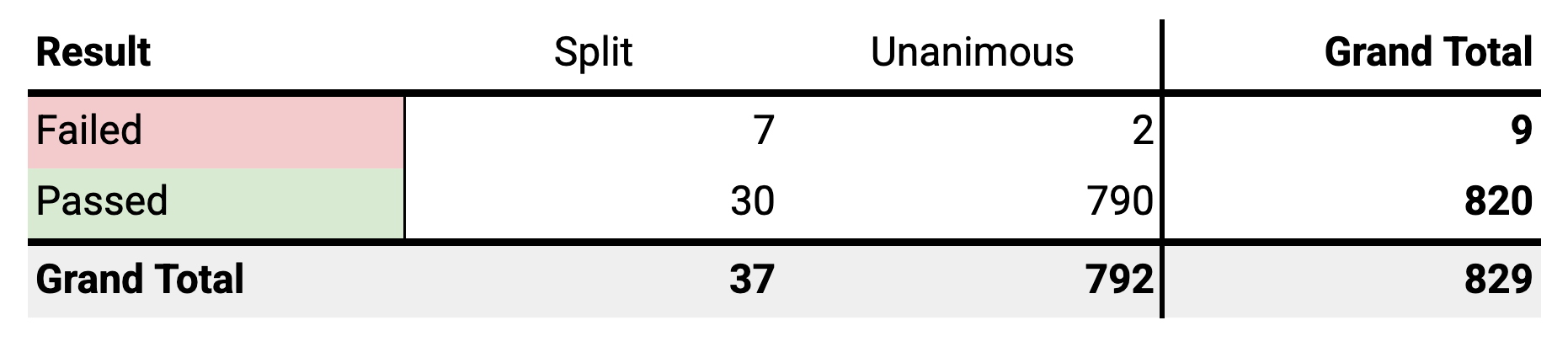
These findings offer a lens into the council’s decision making over the past two years. Between December 2023 and July 2025, the council cast approximately 829 votes. An overwhelming 98.9% of those votes passed, and 96% of passing items were done so unanimously—suggesting broad agreement. But the 37 split votes, including seven that failed, expose ideological fault lines that could shape the outcome of this year’s election.
Consensus on core functions, divisions over development
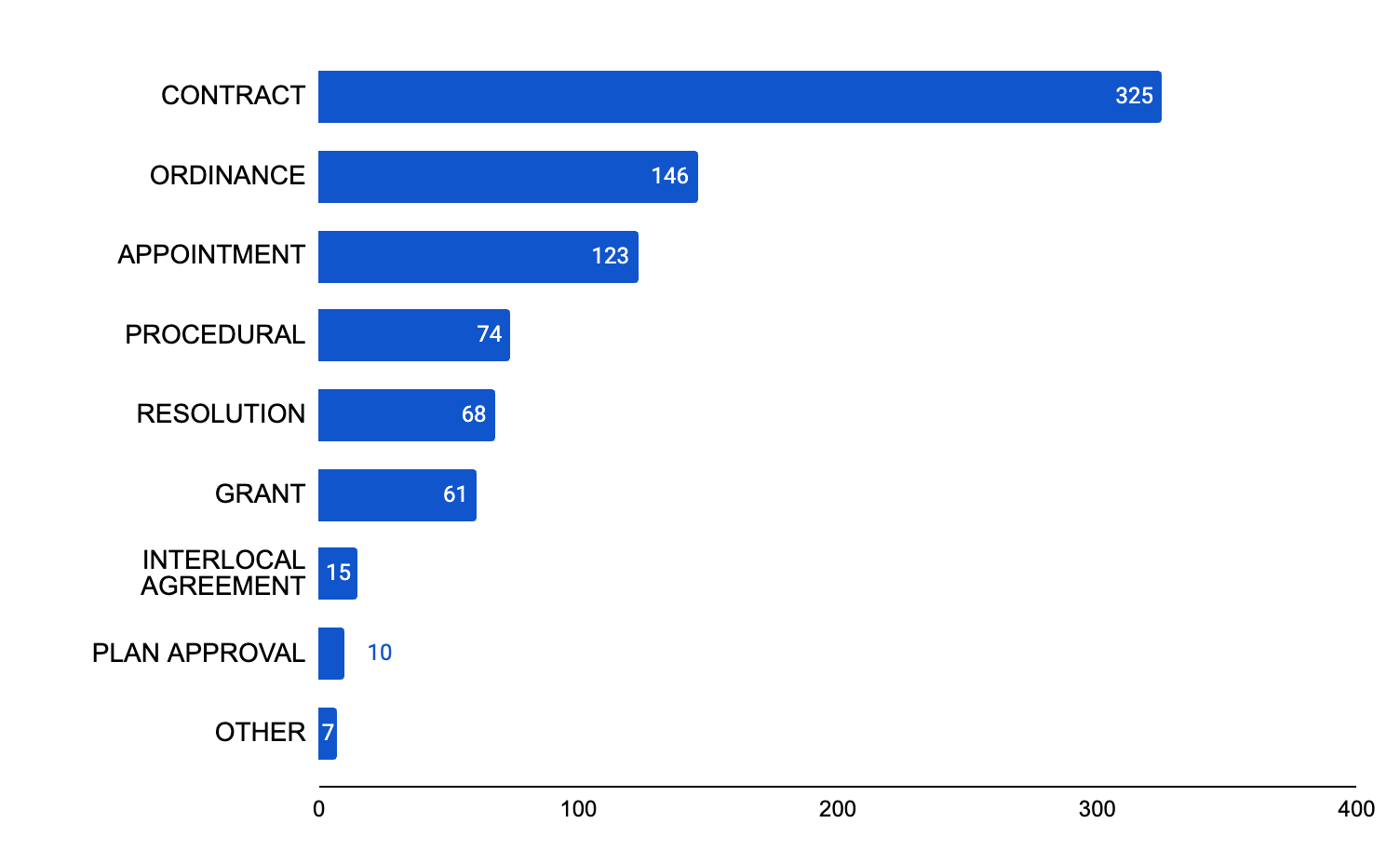
Ordinances tied to zoning and annexation accounted for the majority of both split votes and failed votes, despite ordinances comprising just 18% of the council’s overall agenda. These votes often followed public hearings, drawing intense community scrutiny and media attention. Of the nine failed votes, six were ordinances. Five were ordinances related to rezonings and annexations - the other failed ordinance was a unanimous vote against revising a 2013 law to allow bow hunting of deer on properties of less than two acres.
Of the 37 total split votes, 28 were related to zoning/annexation. Many of those concerned the annexation of parcels into city limits and extension of municipal services. Between 2024 and 2025, this council approved annexation of 1,194 acres into the city limits.
Mayor Williams and council member Middleton voted in favor of every zoning map change and annexation except one (a unanimous vote against the Moriah Ridge annexation in February 2025). Council member Caballero supported all but four while Rist voted against five. Their consistent support for allowing changes to Durham’s development plans contrasts with more cautious stances from council members Baker, Cook and Freeman - revealing a divide over Durham’s development trajectory. Previous reporting by BCPI.OS delved more deeply into these development votes.
Meanwhile, contracts and appointments made up over half of the docket and received near universal support. Only one of the appointments had a split vote and all of them passed. Of the 325 contract votes, only two failed - both involving Shotspotter, a controversial gunshot technology. The contract for ShotSpotter appeared on the agenda twice - a three month extension to the existing contract failed 2-4 in December 2023 and a three year contract renewal failed 2-4 in March 2024. Mayor Williams and council member Middleton voted in favor of both the extension and the renewal, while the remaining council members voted against.
Other council business - taking procedural votes, approving plans, receiving and awarding grants, and declaring resolutions - took up about 30% of the votes and sailed through with little dissent. However, even resolutions, typically symbolic, weren’t immune to division. A resolution in February 2024 calling for an end to violence between Israel and Palestine split the council with Williams and Middleton voting against, while the remaining five council members supported the measure. Lastly, a special budget request to expand funding for a nonprofit summer camp also failed narrowly with Caballero and Rist joining the mayor and Middleton in opposition.
Who holds the power?
According to BCPI.OS data, council member Caballero has won every vote this term except one (a 3-3 tie that failed likely due to the absence of council member Middleton), meaning Caballero voted with the majority in 97% of split decisions. Her consistent alignment with successful outcomes makes her voting record the strongest predictor of city policy direction. Rist ranks second in influence, generally voting in tandem with Caballero.
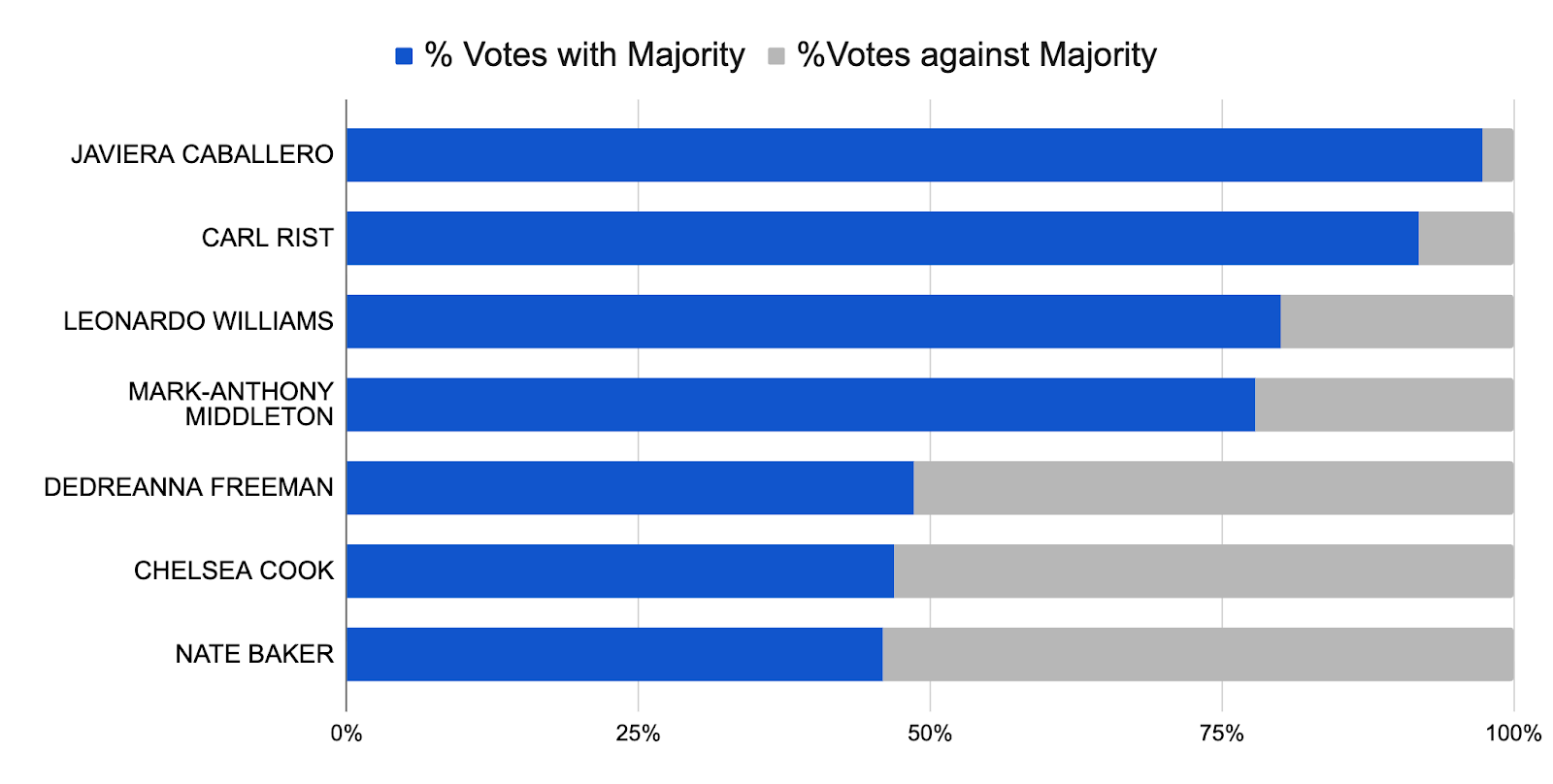
Mayor Williams has supported nearly all motions brought before the council, casting just two dissenting votes on split decisions during his tenure as mayor. One was against a special summer camp funding request made outside normal budgeting procedures; the other was the resolution calling for an end to violence between Israel and Palestine.
Middleton, meanwhile, has cast four “no” votes on split motions that ultimately passed, including two where he stood alone—one concerning language in the Equal Business Opportunity Reform Program and another on a non-binding development plan for the former police station at 505 W Chapel Hill St.
On the other end of the spectrum, council members Nate Baker, Chelsea Cook, and DeDreana Freeman have voted against the majority in just over half of split decisions, signaling a more independent or oppositional stance. BCPI.OS found 11 votes where all three were united in opposition to the council majority. Most of these were related to rezoning for development proposals in the vicinities of Lick Creek and Sandy Creek. All eleven motions would pass in 4-3 decisions.
What this means for voters
As Durham voters prepare to cast their ballots, the council’s voting record offers a roadmap to each member’s priorities. While the Durham City Council largely aligned on the day to day operations of the city, they diverged on development and public safety. Voters satisfied with the city’s current direction may look to Caballero, Middleton, Rist or Williams - and their endorsed candidates - for continuity. Those seeking change may find alignment with Baker, Cook, Freeman, or other challengers.
As Durham heads into a consequential election season, these voting patterns offer more than just numbers—they reveal the values, priorities, and fault lines shaping the city’s future. Early voting begins on September 18 and the municipal primary will be on October 7.
Yah well I heard Leo Williams express the inevitability of developing the Mt. Moriah wildlife corridor plus I am dismayed that he discounted the advice of Durham Planning Commission (whose recommendations are based on the City’s comprehensive plan) as regards Sandy Creek. Human survival depends on respecting biodiversity.
Thank for this analysis, local government matters